Recently, a research team led by Professor He Zhixia and Associate Professor Jiang Zhaochen from our institute, in collaboration with Friedrich-Alexander-Universität Erlangen-Nürnberg and Otto von Guericke University Magdeburg in Germany, published a research paper titled "Simulation of transport phenomena and electrochemical reaction in the PEMFC catalyst layer using a dual network coupled agglomerate model" in the journal Energy Conversion and Management. Dr. Zhang Wei from our institute is the first author of the paper.
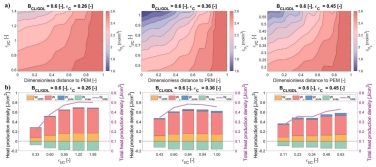
High-temperature proton exchange membrane fuel cells (HT-PEMFCs) offer advantages such as high operating temperatures and strong tolerance to fuel impurities, demonstrating promising application prospects in distributed power generation and transportation. As one of the core components of HT-PEMFCs, the catalyst layer’s structure and composition directly influence the cell's output power, energy conversion efficiency, stability, durability, and cost. This study developed a novel three-dimensional non-isothermal dual-network coupled agglomerate model for the HT-PEMFC catalyst layer, enabling fully coupled analysis of gas, charge, heat transport, and electrochemical reactions within its microstructure. It revealed the influence patterns of the catalyst layer’s structural and component parameters on cell performance. The results indicate that the cell performance is optimal when the catalyst volume fraction is 0.3 and the electrolyte-to-catalyst volume ratio is 1.2. Compared to platinum loading gradients, porosity gradients have a greater impact on enhancing cell performance, and their combined effect exceeds the linear superposition of their individual contributions. These findings provide important guidance for the design of fuel cell catalyst layers.




