On July 3, the Energy Research Institute held a Research Integrity Exchange and the fourth "Yisi" Young Faculty Academic Forum, presided over by Vice Dean Yong Yangchun.
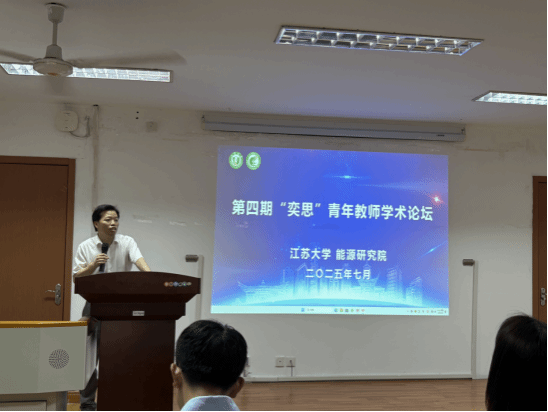
The "Yisi" Young Faculty Academic Forum consisted of three sessions. Jinshan Youth Distinguished Professor Song Zhilong, Associate Researcher Zhang Wei, and Provincial Distinguished Professor Cai Bin were invited to deliver reports titled "Design and System Integration of Intelligent Micro/Nano Gas Sensors," "Structural Design and Performance Regulation of Atomically Dispersed Metal Catalysts," and "Hydrogen Production and Carbon Dioxide Reduction via Photocatalysis Using Organic Self-Assembled Nanodots," respectively. At the beginning of the meeting, Yong Yangchun emphasized the importance of research integrity to the attending faculty and students and read out relevant documents from Jiangsu University regarding research integrity.
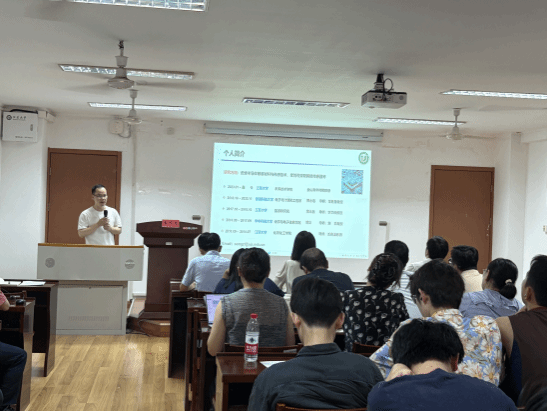
In the first report, Professor Song Zhilong introduced his research findings. By precisely regulating the physicochemical properties of colloidal quantum dots and combining them with a transition metal doping strategy, he successfully developed a gas sensor with low power consumption, high sensitivity, and strong environmental adaptability. Its operating temperature can be reduced to room temperature, and its detection limit reaches the ppb level. Through the integration of 3D nanotube array sensors, the gas sensor achieves accurate gas identification and localization in complex environments, demonstrating exceptional performance especially under conditions of high humidity and interfering atmospheres. Furthermore, the system, utilizing intelligent algorithms and wireless transmission technology, enables real-time monitoring and remote surveillance of indoor trace gases. This provides new solutions for fields such as smart homes, energy security, and healthcare, offering broad application prospects and market potential.
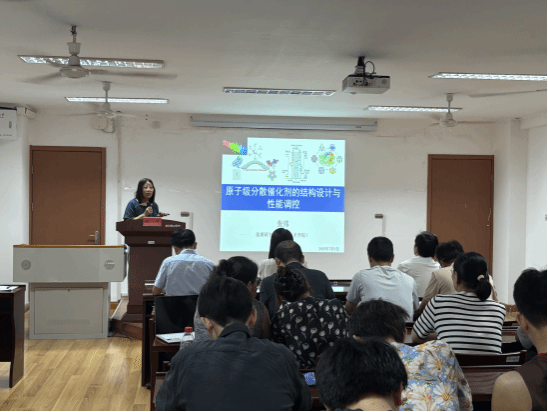
In the second report, Associate Researcher Zhang Wei introduced the excellent performance of dual-atom catalysts (DACs) and cluster-loaded single-atom catalysts. These can construct synergistic active centers and optimize the adsorption energy of intermediates, exhibiting superior performance beyond that of single-atom catalysts in electrocatalytic reactions such as the oxygen reduction reaction and oxygen evolution reaction. The synergistic catalytic effects between single atoms, as well as between clusters and single atoms, not only break through the performance limitations of single-atom catalysts but also provide a novel strategy for developing highly active and stable atomically dispersed metal electrocatalysts.
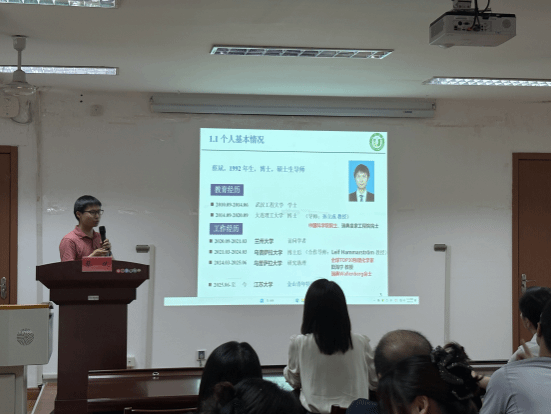
In the third report, Professor Cai Bin presented his research findings. He focused on the preparation of organic self-assembled nanodots and their application in photocatalytic hydrogen production and carbon dioxide reduction. By constructing intermolecular charge hopping channels, he successfully achieved charge separation states with lifetimes ranging from milliseconds to seconds, significantly enhancing the efficiency of photocatalytic hydrogen evolution. Additionally, by constructing nanoscale catalysts, he shortened the charge transport distance and improved the conversion efficiency of reducing carbon dioxide to carbon monoxide under aqueous conditions.
After the reports, the attending faculty and students enthusiastically raised questions regarding the content, fostering a lively atmosphere of on-site exchange. Over 80 faculty and students from the Energy Research Institute, the School of Energy and Power Engineering, and the School of Chemistry and Chemical Engineering participated in this forum.




