Recently, a research team led by Professor He Zhixia from our institute published a research paper titled "Investigation of Scavenging Performance in an OP2S Engine with a Novel EGR-Air Stratified Strategy" (Energy 328, 2025, 136562) in the journal Energy. Associate Professor Jin Yu, a member of the team, served as the first author, while Professor He Zhixia and Associate Professor Leng Xianyin were the corresponding authors.
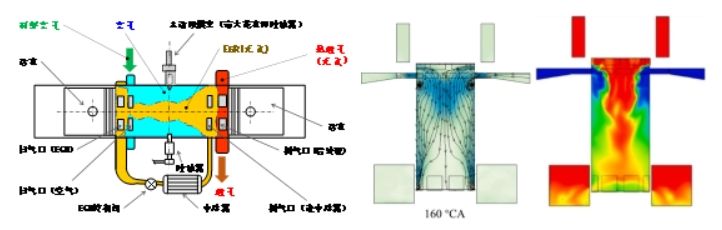
Opposed-piston two-stroke (OP2S) engines, known for their compact design, lightweight construction, and high thermal efficiency, are widely used in aerospace, special-purpose vehicles, and distributed energy systems. However, achieving high scavenging efficiency often comes at the cost of reduced trapping efficiency. In spark-ignition engines, lower trapping efficiency worsens the conditions for catalytic reduction of NOx by three-way catalysts, resulting in higher NOx emissions. To address this issue, this study proposed a novel EGR–air stratified scavenging strategy. By controlling the timing and flow patterns of EGR and air introduction during the scavenging process, the spatial distribution of exhaust gas and air in the scavenging flow was regulated. This approach simultaneously achieved high scavenging and air-trapping efficiencies of 90% and 82%, respectively.




