Recently, a research team led by Professor He Zhixia from our institute published a research paper titled "Pore network simulation of HT-PEMFC GDL using radical Voronoi tessellation: Analysis of oxygen, phosphoric acid solution, and charge transport" in the International Journal of Heat and Mass Transfer. Doctoral student Zhang Wei from the Energy Research Institute is the first author, with Professor He Zhixia and Associate Professor Jiang Zhaochen serving as corresponding authors.
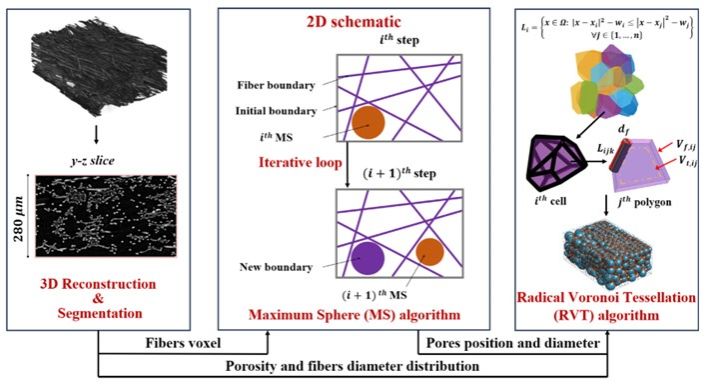
High-temperature proton exchange membrane fuel cells (HT-PEMFCs) offer significant advantages in distributed power generation, vehicle auxiliary power, drones, military portable power sources, industrial waste hydrogen utilization, and off-grid power supply due to their high energy conversion efficiency, thermal utilization, strong tolerance to impurity gases such as carbon monoxide, and simplified water and thermal management. Overcoming the bottlenecks in constructing multi-scale, cross-scale, and multi-physics models for HT-PEMFCs at the microscopic, mesoscopic, macroscopic, and system levels, and achieving high-precision, high-fidelity numerical simulation predictions of HT-PEMFC performance, is crucial for developing efficient and highly reliable HT-PEMFCs. Based on the three-dimensional morphology of a carbon paper gas diffusion layer (GDL) reconstructed from micro-CT scans, this study proposes a novel pore network construction method combining the maximal sphere (MS) algorithm and radical Voronoi tessellation (RVT). This approach accurately reflects the real microstructure, overcoming the limitations of conventional regular pore network models in predicting GDL liquid saturation, concentration loss, effective oxygen diffusion coefficient, and ohmic loss. The study reveals the influence of inlet liquid coverage, hydrophilic pore fraction, fiber diameter, and porosity on liquid saturation, effective gas diffusion coefficient, and voltage loss in the GDL of HT-PEMFCs, providing important guidance for the design of high-performance GDLs in HT-PEMFCs.




