On April 8, Dr. Jung-Myung Kim from Loughborough University, UK, was invited to deliver an online academic report entitled "Efficient Synergistic Conversion of Chemical Energy and Heat into Electricity Using Flow Batteries." The report was chaired by Professor Qian Xu of the Institute for Energy Research, and more than thirty faculty members and students of the Institute actively attended the event.
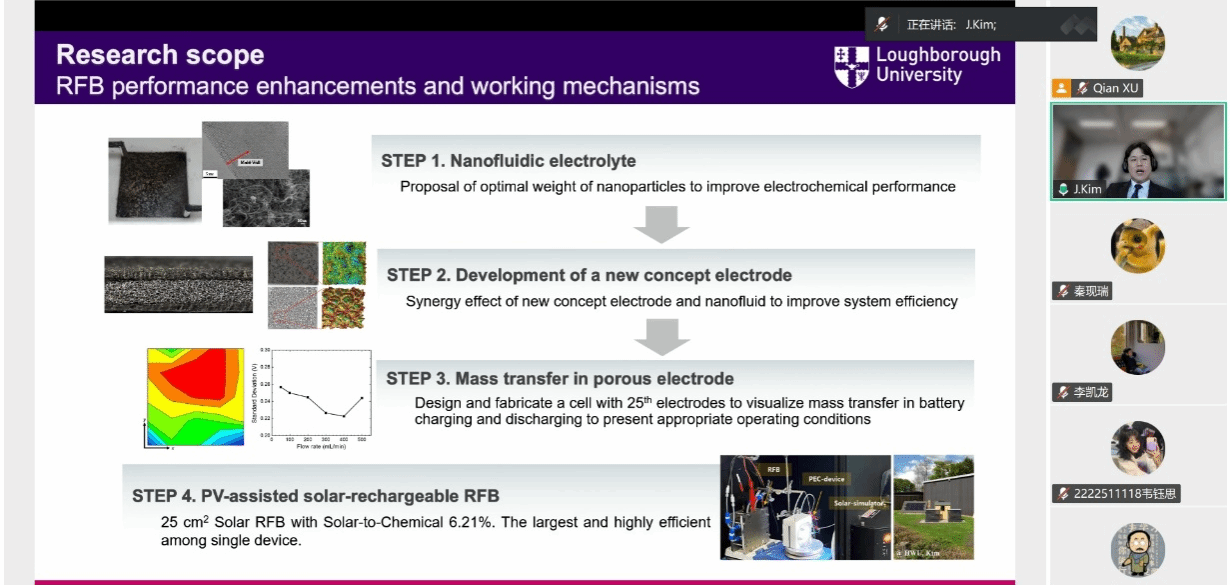
In his report, Dr. Kim systematically reviewed the research progress of thermoelectric conversion technologies. He pointed out that thermoelectric conversion technology can directly convert low-grade waste heat into electricity, which is of great significance for improving energy utilization efficiency. The report proposed an innovative electrochemical thermoelectric conversion route that uses flow batteries as the core energy conversion device. Unlike traditional heat engines that rely on temperature gradients to do work, this method designs redox couples with temperature-dependent electrode potentials, so that thermal energy is directly stored as electrochemical energy during thermal charging and then released as electricity during the discharge stage. Dr. Kim emphasized that, owing to their decoupled energy and power characteristics, scalable modular design, and excellent cycling stability, flow battery systems serve as an ideal platform for thermoelectric conversion. On this basis, he systematically discussed the selection principles of redox couples suitable for thermoelectric conversion, optimization strategies for thermal charging and discharging cycles, and pathways to improve system energy efficiency, providing theoretical guidance and an experimental foundation for developing efficient and stable thermoelectric conversion technologies. In the exchange session, participating faculty and students held heated discussions with Dr. Kim on issues such as redox couple selection principles, the stability of thermal charging and discharging cycles, and pathways to improve system energy efficiency. Drawing on his own research experience, Dr. Kim patiently answered the questions raised by the faculty and students. The online discussion was lively, and participants stated that they had benefited greatly from the report.
Dr. Jung-Myung Kim is currently an Associate Researcher at Loughborough University in the UK and the industrial collaboration lead of the Thermally Assisted Water Electrolysis Laboratory. He received his doctorate from Changwon National University, South Korea, in 2021. Afterward, he worked as a postdoctoral researcher for three years at the Korea Advanced Institute of Science and Technology and Heriot-Watt University in the UK, before joining Loughborough University. His expertise lies in energy conversion and efficient energy utilization, in particular making major breakthroughs in the efficient utilization of low-grade thermal energy. He has published more than thirty SCI papers, which have been cited over 1,500 times, and holds a number of invention patents in South Korea and the UK. Among them, the integrated heat pump-flow battery device obtained the first UK patent in this direction and has been applied on a small industrial scale.




