Constrained by the intermittency of renewable energy, advanced electrical energy storage (EES) technologies are urgently needed to reduce dependence on fossil fuels. By introducing a solid-state energy storage mechanism, redox-targeting flow batteries (RTFBs) retain the advantage of decoupling power and capacity while overcoming the bottleneck of low energy density in conventional flow batteries. Nevertheless, issues such as solid–liquid matching and stability remain limiting factors.
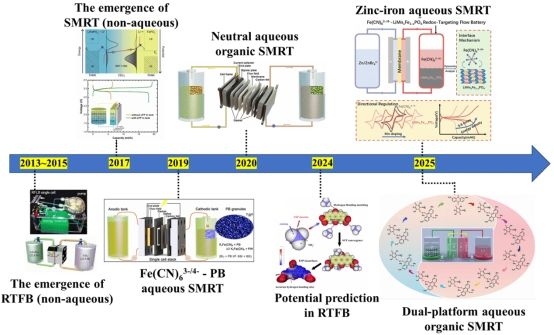
Focusing on the latest progress in this field, this paper highlights aqueous and non-aqueous systems, the pairing of redox mediators (RMs), and the structural design of solid materials (SMs). In addition, it emphasizes the important role of machine learning in high-throughput screening, and points out that deeply integrating material innovation with data-driven approaches is the key pathway to advance these batteries toward large-scale, grid-level energy storage, providing a clear strategic roadmap for the development of next-generation high-performance and scalable flow batteries.
This work was recently published in the Chemical Engineering Journal (DOI: 10.1016/j.cej.2026.176969). The first author is Xiaokun He, a doctoral student at Jiangsu University, with Jiangsu University serving as the first corresponding affiliation. Professor Qian Xu and Professor Ya Ji of Shanghai Jiao Tong University are co-corresponding authors.




