To celebrate the 105th anniversary of the founding of the Communist Party of China, the Institute for Energy Research held a series of institute-level high-quality development activities titled "Party Building Leadership Unites Strength, Diligent and Earnest Action Promotes Development" in late June and early July. The series consisted of two parts: the "Exhibition of Frontier Academic Achievements in Energy Science and Technology" and the "Seminar on High-Quality Development." Since the Institute launched this brand activity during the centenary of the Party in 2021, this is the sixth consecutive year of the special "July 1st" series.
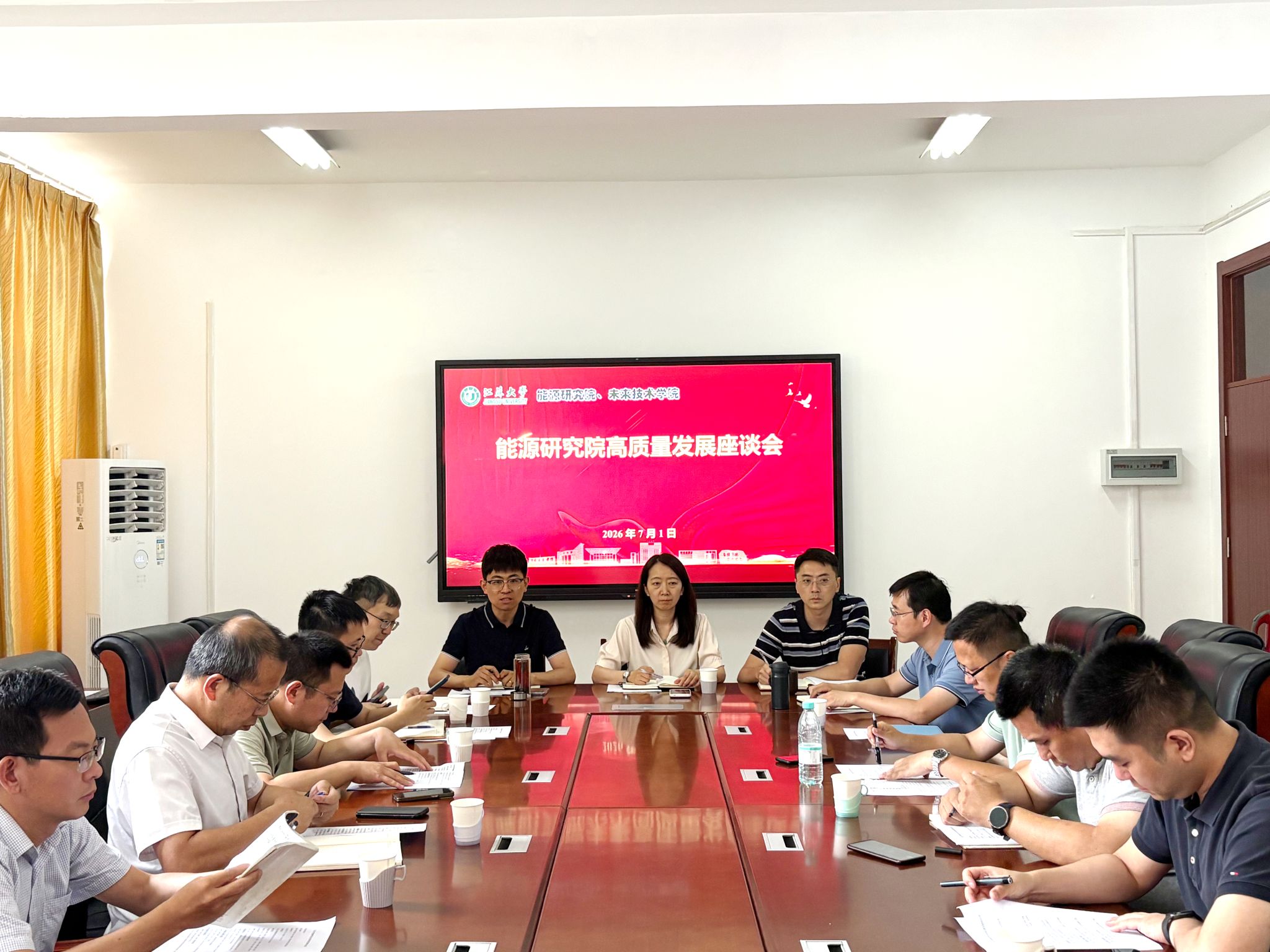
On July 1, the Institute held the high-quality development seminar in Meeting Room 208. All Institute leadership and faculty representatives attended, and the meeting was presided over by Vice Dean Cheng Ming. Under the theme of "Focusing on the Dual Carbon Strategy, Deepening Industry-Education Integration, and Empowering the High-Quality Development of the Institute of Energy Research," the seminar held in-depth discussions on key tasks such as talent cultivation, scientific research, and faculty development.
Before the formal discussion, Dean He Zhixia led the study of the article "Take Solid and Earnest Action to Write an Era Answer Worthy of the People." Combining the education on establishing and practicing a correct view of political achievements, she put forward requirements: all faculty and staff should firmly establish a pragmatic and truth-seeking work orientation, run the correct view of political achievements through the whole process of talent cultivation, research innovation, and discipline development, and drive every task deeper, more solidly, and toward concrete results through diligent responsibility.
After the guided study, the seminar formally began. The participants exchanged views one by one around five core topics: first, reconstructing the undergraduate training system and deepening the "real problems solved for real" model; second, strengthening a high-level postgraduate training highland and promoting "work-study alternation" and industry-education integration; third, focusing on the dual carbon strategy and disciplinary intersection, and exploring medium- and long-term research plans for young faculty as well as cross-school and cross-institute collaboration models within the division; fourth, adhering to "recruitment and cultivation in parallel" and broadening international horizons, and giving play to the "mentor-to-mentee" role of national-level talents; fifth, empowering the all-round growth of young faculty and optimizing the evaluation mechanism and research ecosystem. Participants offered suggestions and ideas based on their actual positions and exchanged views thoroughly.
Finally, Dean He Zhixia delivered concluding remarks. In response to the development difficulties and work ideas raised by the participants, she put forward several suggestions: first, refine core strengths based on disciplinary characteristics, engage precisely with high-quality enterprises, and deepen industry-university-research cooperation; second, lay out in advance the interdisciplinary frontier directions in the energy industry and the low-carbon, zero-carbon and carbon-neutrality fields, and join forces with enterprises to carry out high-level research and technological breakthroughs; third, regularly invite well-known experts from on- and off-campus to hold thematic seminars and frontier academic reports to broaden the research horizons of faculty and students. She emphasized that the Institute will continue to deepen industry-education integration, coordinate the advancement of talent cultivation, research innovation, and faculty development, focus on major platforms, major projects, and major achievements, and drive the high-quality development of all Institute undertakings through solid and earnest action.
To actively serve the national major dual carbon development strategy, the Center for Cross-Frontier Technologies of Carbon Neutrality of the Institute of Energy Research (jointly administered with the Future Technology College) was established in September 2025. Led by national-level talents and leveraging its strength in gathering high-level overseas talents, the center has built a multidisciplinary cross-innovation research platform, striving to break through major scientific bottlenecks in low-carbon and zero-carbon energy and power fields and provide comprehensive, all-round solutions for the national dual carbon strategy. Recently, faculty and students of the Center have made important research progress in the interdisciplinary fields of energy and power, chemistry, and materials, and their academic achievements have been published successively in internationally authoritative journals such as Nature Chemistry, Nature Communications, Angew. Chem., Energy Convers. Manag., Appl. Catal. B Environ., and Combust. Flame. The current "Celebrating the July 1st Day: Exhibition of Frontier Academic Achievements in Energy Science and Technology" displays these academic achievements in the Institute lobby, attracting many faculty and students to stop, observe, exchange, and learn, fully demonstrating the innovation efficacy of interdisciplinary integration.




