As core materials for perovskite solar cells (PSCs), hole-transporting materials (HTMs) play a crucial role in efficiently extracting holes and protecting the perovskite layer from environmental erosion. At present, the most widely used HTM, Spiro-OMeTAD, has a complex synthesis process and high cost, which limits its large-scale application in PSCs. Therefore, designing and developing new low-cost, high-performance HTMs has become one of the research priorities in the field of perovskite solar cells. Among the candidate materials, phenothiazine (PTZ) and phenoxazine (POZ) derivatives, with their unique aromatic conjugation, have shown great potential. However, most existing designs adopt only a single PTZ or POZ building unit. Although the two structures are similar, replacing sulfur with oxygen leads to marked differences in electron distribution and steric effects. The possible synergistic effect of combining these two complementary units had not been adequately explored, representing an important knowledge gap in the field.
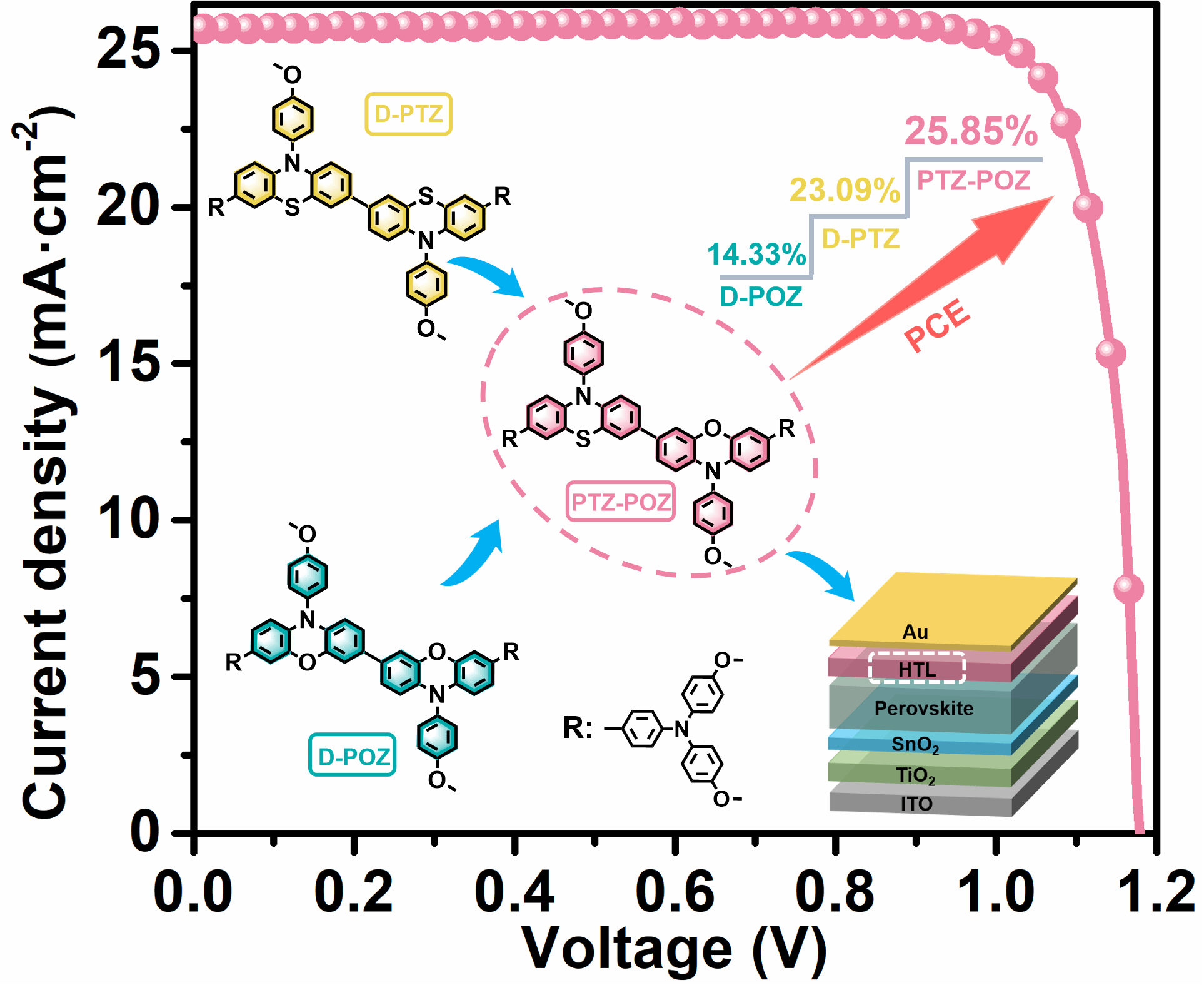
To this end, the team led by Professor Ming Cheng of Jiangsu University innovatively proposed a hybrid cross molecular design strategy and successfully developed a new hole-transporting material (PTZ-POZ) based on a phenothiazine-phenoxazine hybrid core. Systematic comparison showed that this hybrid design enabled PTZ-POZ to combine the advantages of both D-PTZ and D-POZ, exhibiting better solubility, a more favorable thin-film morphology, the highest hole mobility, and the most effective defect passivation ability, thereby effectively improving the photovoltaic performance of the devices. The PSCs based on PTZ-POZ achieved outstanding optoelectronic performance: the power conversion efficiency (PCE) of small-area devices (0.0625 cm2) reached as high as 25.85%, which is among the highest efficiencies reported to date for PSCs based on phenothiazine/phenoxazine-core HTMs; the PCE of large-area devices (1.0 cm2) also reached 23.23%. In addition, the devices showed excellent long-term stability, retaining more than 90% of their initial efficiency after 1,080 hours under ambient conditions at 40-50% humidity and room temperature. Therefore, this study not only provides an efficient, stable, and low-cost new hole-transporting material for PSCs through an innovative hybrid cross molecular design, but also reveals in depth the interaction mechanism between different heteroatom units within the HTM molecule and its influence on optoelectronic performance, offering new insights for the molecular engineering of high-efficiency HTMs in the future.
This achievement was recently published in Angew. Chem. Int. Ed. The first authors are Ding Xingdong, a doctoral graduate of Jiangsu University, and Zhou Xiaowen, a master's graduate of Jiangsu University.




