Recently, the team led by Professor Ming Cheng of the Institute for Energy Research published its latest research in Angewandte Chemie International Edition under the title "Alkyne-Based Dual-Function Self-Assembled Monolayers for Efficient and Stable p-i-n Perovskite Solar Cells." Jiangsu University is the first affiliation. The first author is Xia Ziyang, a doctoral student of the Institute for Energy Research, and the corresponding authors are Researcher Chen Cheng, Professor Ming Cheng, and Academician Sang Il Seok from the Ulsan National Institute of Science and Technology (UNIST), South Korea.
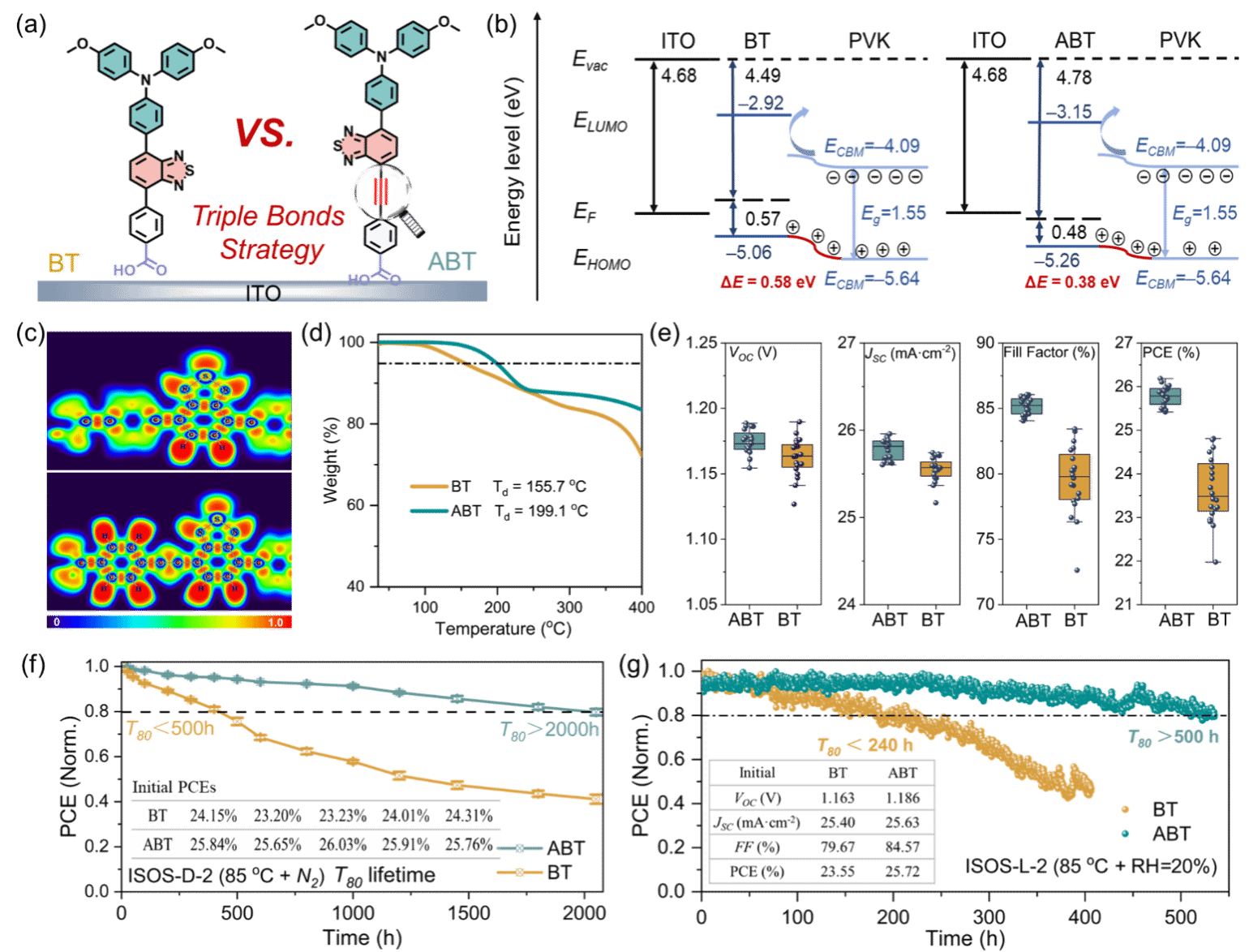
Nanoscale self-assembled monolayers (SAMs) are key emerging hole-transporting layers in inverted (p-i-n) perovskite solar cells, and their performance directly determines the hole-extraction efficiency and long-term stability of the devices. Conventional SAM materials that use benzene rings or carbon-carbon double bonds as linking groups have intrinsic drawbacks: benzene rings readily twist and interrupt pi-electron delocalization, while carbon-carbon double bonds are prone to cis-trans isomerization and thermal degradation, leading to charge recombination and device aging. To address this bottleneck, this study innovatively introduced linear, rigid alkyne groups as linking groups and developed a new SAM material, ABT, achieving three major performance breakthroughs. First, continuous pi-electron delocalization markedly enhances vertical hole transport. Second, the high bond dissociation energy and rigid structure effectively suppress thermally induced conformational distortion and degradation. Third, the enhanced molecular dipole moment enables precise tuning of the ITO electrode work function and lowers the hole-extraction barrier. The ABT-based devices achieved a power conversion efficiency of 26.19%, outperforming the conventional alkyne-free SAM material BT (24.92%) and ranking among the leading levels for SAM materials of this type. More importantly, the ABT devices showed a significant improvement in stability: after aging at 85 degrees Celsius for 2,000 hours, they retained 80.6% of their initial efficiency, with a T80 lifetime exceeding 500 hours; their stability was nearly doubled compared with the conventional BT material.
This work not only provides a self-assembled monolayer material with excellent performance and good stability, but also establishes a rational molecular design strategy that helps improve the efficiency and durability of perovskite solar cells.




